The president appoints the Prime Minister. Can he dismiss him? No: the Constitution provides that the Prime Minister's appointment ends when the resignation of the Government is tendered. As a general rule, an instrument of the president also bears the signature of a minister: this is countersignature. Article 19 exempts the instruments of eight provisions from it; even there, the text most often brings in someone else, before or after the president. His most visible powers (the armed forces, pardon, treaties, appointments) are not on that list: they are countersigned.
Page updated · texts read on Légifrance between 30 September 2026 and 11 October 2026
“The President of the Republic shall appoint the Prime Minister. He shall terminate the appointment of the Prime Minister when the latter tenders the resignation of the Government.” (article 8). The appointment rests on his signature alone; the end of the appointment requires an act of the Prime Minister, the resignation he tenders.
To measure the gap between the image of a president who decides alone and what the text says, the page starts from the only list the Constitution draws up: the instruments the president signs without countersignature, that is, without the signature of a minister next to his own. It reads them one by one, and records an element only if it is written, word for word, in the article. The Constitution is quoted in the English translation published by the Conseil constitutionnel, itself checked word for word; the French text, read on Légifrance, remains the reference.
Status: a documentary reading of the French Constitution, without legal certification. Each quotation is checked word for word; its classification is a reading, justified cell by cell further down.
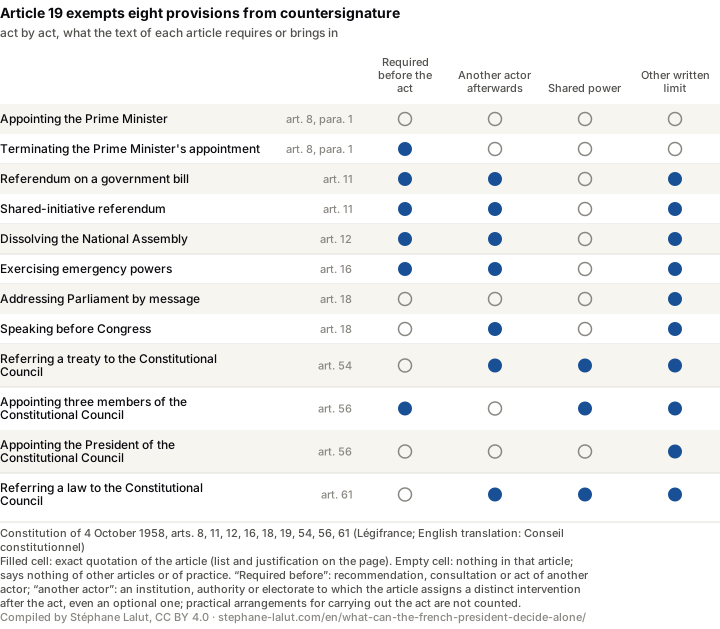
The table: one row per act, grouped by provision of article 19; one column per element. Filled cell: the article itself contains an exact quotation of the element; empty cell: that article does not contain it, which says nothing of other articles or of practice. Another actor afterwards: an institution, authority or electorate to which the article assigns a distinct intervention, after the president’s act, including an optional one; mere practical arrangements for carrying out the act are not counted.
The finding in one sentence. Of the twelve acts that article 19 exempts from countersignature, nine bring in someone else, before or after the president, in the very text of their article.
This count reads the text of each article, not practice nor the rest of the Constitution.
Stepping in does not always mean blocking: before dissolving, the president must consult the Prime Minister, not obtain his agreement. That leaves three acts: appointing the Prime Minister, addressing Parliament by message and appointing the President of the Constitutional Council. For these, the article provides for neither a recommendation, consultation or act of another actor beforehand, nor the intervention of another actor afterwards.
What does “deciding alone” mean for a French president?
Article 19 sets the rule: “Instruments of the President of the Republic, other than those provided for under articles 8 (paragraph one), 11, 12, 16, 18, 54, 56 and 61, shall be countersigned by the Prime Minister and, where required, by the ministers concerned.” The exceptions are therefore the acts no minister has to sign. In the text, this is what comes closest to “deciding alone”, without being the same thing.
Without countersignature does not mean without condition. The text may require, before the act, a recommendation (for the referendum), a consultation (for dissolution) or an act of another actor (the resignation the Prime Minister tenders). It may bring in afterwards the voters, Parliament or the Constitutional Council, sometimes merely as a possibility: a statement before Congress may be followed by a debate, without a vote. Other authorities may hold a power of the same kind. Finally, the text may limit the act in time, in subject or in effect. These are the four columns of the table above; a single act may fill several.
Three levels of reading. The table and the counts read only the text of the article referred to in article 19. The entries below add what other articles, Institutional Acts and two court decisions say. The section on the policy of the Nation then deals with practice. These last two levels change the scope of an act, never the content of a cell.
An example. To appoint the Prime Minister, article 8 brings in no one else. But the Government appointed falls under article 20: “It shall be accountable to Parliament in accordance with the terms and procedures set out in articles 49 and 50”. If the National Assembly censures it, it must tender its resignation (article 50).
Which acts does the president sign without countersignature?
One entry per provision, eight in all: the short answer first, then, when unfolded, the detail quotation by quotation (what the text requires before the act, who steps in afterwards, what the act produces, what other texts add). They are read alongside the role that article 5 gives the president: to ensure due respect for the Constitution and to ensure, “by his arbitration, the proper functioning of the public authorities and the continuity of the State”.
Can the president appoint and dismiss the Prime Minister?
Appoint, yes: his signature alone is enough. Dismiss, no: article 8 provides only for the resignation the Prime Minister tenders. Article 50 obliges him to tender it when the National Assembly passes a resolution of no-confidence; it is not a dismissal by the president.
The president, for two acts of article 8: “The President of the Republic shall appoint the Prime Minister. He shall terminate the appointment of the Prime Minister when the latter tenders the resignation of the Government.”
Required before the act
To appoint, article 8 requires neither a recommendation nor a consultation. To terminate the appointment, it requires an act of the Prime Minister: tendering the resignation of the Government.
Who steps in afterwards
Article 8 brings in no other actor after the appointment. The Government appointed is accountable to Parliament “in accordance with the terms and procedures set out in articles 49 and 50” (art. 20).
Effect of the act
The appointment takes effect by his signature alone. For the end of the appointment, the tendering of the resignation is the only route article 8 describes.
Beyond this article
Article 50 describes the case in which this resignation becomes compulsory: when the National Assembly passes a resolution of no-confidence or fails to endorse the Government programme or a general policy statement, “the Prime Minister shall tender the resignation of the Government to the President of the Republic”. The obligation falls on the Prime Minister and arises from a vote of the Assembly: it is not a dismissal by the president.
Can the president call a referendum alone?
Not on his own initiative: it takes a recommendation from the Government or from the two Houses, or else an initiative of one fifth of the members of Parliament supported by one tenth of the registered voters. The voters then decide, and only on the subjects the article lists.
The president submits the text to a referendum; the voters adopt or reject it.
Required before the act
Two routes. For a government bill, a recommendation from the Government “when Parliament is in session” or a joint motion of the two Houses, published in the Journal officiel. For a shared-initiative private members' bill, the initiative “of one fifth of the members of Parliament, supported by one tenth of the voters enrolled on the electoral lists”, review by the Constitutional Council, then the absence of consideration by the two Houses within the period set by the Institutional Act.
Who steps in afterwards
Where the referendum is held on the recommendation of the Government, the latter makes before each House a statement which “shall be followed by a debate”. Then the voters vote. If the text is adopted, the president “shall promulgate the resulting statute within fifteen days following the proclamation of the results of the vote”: promulgation is his own act, bound by a time limit.
Effect of the act
The subject is limited: organisation of the public authorities, reforms relating to the economic, social or environmental policy of the Nation and to the public services contributing thereto, authorisation to ratify certain treaties. In the shared-initiative referendum, if the two Houses have not considered the bill within the period, the French text uses the indicative « la soumet » (submits it), whereas the English translation published by the Conseil constitutionnel reads “may submit it to a referendum”.
Beyond this article
The Constitutional Council “shall ensure the proper conduct of referendum proceedings” and proclaims the results (art. 60); it is consulted by the Government on the organisation of referendum proceedings (Ordinance no. 58-1067, art. 46: « est consulté par le Gouvernement sur l'organisation des opérations de référendum »); it reviews shared-initiative bills “before they are submitted to referendum” (art. 61). During a vacancy or incapacity, the president's functions are exercised in the interim, except those of articles 11 and 12 (art. 7).
Can the president dissolve the National Assembly without the Prime Minister's agreement?
Yes, without anyone's agreement: he must only consult the Prime Minister and the presidents of the two Houses. The voters then vote, twenty to forty days later, and no further dissolution may take place in the year following those elections.
He must consult the Prime Minister and the Presidents of the Houses: “after consulting the Prime Minister and the Presidents of the Houses of Parliament”. Consultation is required, not agreement.
Who steps in afterwards
The voters: “A general election shall take place no fewer than twenty days and no more than forty days after the dissolution.” Then the new Assembly “shall sit as of right on the second Thursday following its election”.
Effect of the act
The dissolution takes effect by his decision alone; the majority that emerges from the polls belongs to the voters. “No further dissolution shall take place within a year following said election.”
Beyond this article
“The National Assembly shall not be dissolved during the exercise of such emergency powers” (art. 16). During a vacancy or incapacity, the president's functions are exercised in the interim, except those of articles 11 and 12 (art. 7).
What are the emergency powers of article 16?
They are the measures the president may take in the face of a serious and immediate threat, when the public authorities no longer function properly, and only after formal consultations. Parliament then sits as of right; the Constitutional Council may be asked after thirty days to examine whether the conditions still apply, and carries out that examination as of right after sixty. The text gives its opinion no effect that would end these powers.
The president “shall take measures required by these circumstances”.
Required before the act
Three stages. To use them, two cumulative conditions — a serious and immediate threat to the institutions, the independence of the Nation, the integrity of its territory or the fulfilment of its international commitments, and the interruption of “the proper functioning of the constitutional public authorities” — and formal consultation of the Prime Minister, the Presidents of the Houses and the Constitutional Council. For each measure: “The Constitutional Council shall be consulted with regard to such measures.”
Who steps in afterwards
“Parliament shall sit as of right.” For their continuation: after thirty days, the matter may be referred to the Constitutional Council by the President of the National Assembly, the President of the Senate, sixty deputies or sixty senators, to decide whether the conditions still apply; it does so as of right after sixty days and at any moment thereafter, “by public announcement”.
Effect of the act
The power is bounded by its purpose: to provide the public authorities, “as swiftly as possible”, with the means to carry out their duties. Its duration is examined by the Constitutional Council; the article gives this public announcement no effect that would end the emergency powers.
Beyond this article
The administrative courts have declared themselves without jurisdiction over the decision to use article 16, an act of government « dont il n'appartient au Conseil d'Etat ni d'apprécier la légalité, ni de contrôler la durée d'application » (whose legality and duration the Conseil d'État may neither assess nor review), and over a measure taken in the matters of article 34, which « présente le caractère d'un acte législatif » (has the character of a legislative act) (Conseil d'État, Assembly, 2 March 1962, Rubin de Servens; our translation).
Can the president address Parliament?
Yes, in two ways: a message read out before the two Houses, or a statement before Parliament convened in Congress. No vote follows; only the statement may be followed by a debate, in his absence.
The president, in two forms: messages “which he shall cause to be read aloud” to the two Houses, or a statement before Parliament “convened in Congress for this purpose”.
Required before the act
The article requires neither a recommendation nor a consultation, for either form. When not in session, the Houses “shall be convened especially for this purpose”.
Who steps in afterwards
The message is read aloud before the Houses, and such messages “shall not give rise to any debate”. The statement before Congress may be followed, “in his absence”, by a debate “without vote”: a possible intervention, not a compulsory one.
Effect of the act
The effect is that of speech: no vote follows, either on the message or on the statement.
Can the president have a treaty reviewed on his own?
He may refer it to the Constitutional Council, as may the Prime Minister, the president of either House, sixty Members of the National Assembly or sixty Senators; the Council decides. If a clause is held unconstitutional, ratification must wait for a revision of the Constitution.
Nothing is required before the referral. The Prime Minister, the President of each House, sixty deputies or sixty senators can also refer it to the Council.
Who steps in afterwards
The Constitutional Council, which reviews; then, if it holds that a clause is contrary to the Constitution, the body that amends the Constitution, since authorisation to ratify “may be given only after amending the Constitution”.
Effect of the act
The president obtains the review, not the decision.
Who appoints the members of the Constitutional Council?
He appoints three of the nine members, but the committees of the two Houses may prevent it if their negative votes, added together, reach three fifths of the votes cast. He also designates the president of the Council, without prior opinion, but from among the Council's members.
Two separate acts. The president appoints three of the nine members; three others are appointed by the President of the National Assembly, three by the President of the Senate. He also appoints the President of the Council: “The President shall be appointed by the President of the Republic.”
Required before the act
For the three members, before the appointment, “The procedure provided for in the last paragraph of article 13 shall be applied to these appointments”: public consultation of the relevant standing committee in each House, and no appointment “when the sum of the negative votes in each committee represents at least three fifths of the votes cast by the two committees” (art. 13). For the appointment of the President of the Council, article 56 provides for no consultation.
Who steps in afterwards
After the appointment, article 56 brings in no other actor. Members hold “a non-renewable term of nine years”; the President of the Council “shall have a casting vote in the event of a tie”.
Effect of the act
The choice is his; for the members, a qualified opposition of the two committees can prevent it.
Beyond this article
The President of the Council is « nommé par décision du Président de la République » and « choisi parmi les membres du conseil, nommés ou de droit » (appointed by decision of the President of the Republic, chosen from among the members of the Council, appointed or ex officio: Ordinance no. 58-1067, art. 1, our translation): the appointment concerns a person who is already a member, appointed or ex officio like former Presidents of the Republic.
Can the president have a law reviewed before it is promulgated?
Before promulgation, he may refer a statute to the Constitutional Council, as may other authorities. The Council rules, within a month, on whether it is constitutional, and the referral suspends the time limit for promulgation.
The Constitutional Council, which rules on the conformity of the law with the Constitution.
Required before the act
No recommendation or consultation is required; the moment is written: “before their promulgation”. The Prime Minister, the Presidents of the two Houses, sixty deputies or sixty senators can also refer the law.
Who steps in afterwards
The Constitutional Council, which “must deliver its ruling within one month” (eight days in cases of urgency, at the Government's request).
Effect of the act
Referral “shall suspend the time allotted for promulgation”. It obtains a review of constitutionality, not a judgement of expediency.
Which powers are attributed to him personally although they are countersigned?
Commander-in-Chief, pardon, treaties, decrees, appointments: these are the most visible attributes of the office, and none appears in the list of article 19. When they give rise to an instrument of the president, that instrument is subject to the countersignature this article provides for. Some also bring in Parliament or another institution: part of the treaties may be ratified only by an Act of Parliament, and some appointments go through a consultation of the parliamentary committees or through the High Council of the Judiciary.
Does the president choose ministers alone?
No: he appoints the ministers and ends their appointment on the recommendation of the Prime Minister, who countersigns.
The president, “On the recommendation of the Prime Minister” (art. 8, para. 2).
Required before the act
A recommendation of the Prime Minister.
Who steps in afterwards
The Prime Minister, who recommends and countersigns.
Effect of the act
Neither the appointment nor the dismissal of a minister is in the list of article 19.
Can the president refuse to promulgate a law?
The text provides for no veto: he must promulgate within fifteen days, a time limit suspended if the law is referred to the Constitutional Council (article 61). He may only ask for a further deliberation, which Parliament may not refuse and whose outcome is Parliament's to decide.
The president promulgates; Parliament deliberates again if he asks.
Required before the act
No recommendation or consultation is required before the act.
Who steps in afterwards
Parliament: “Such reopening of debate shall not be refused”, and Parliament votes again.
Effect of the act
He promulgates within fifteen days following the final passage of an Act and its transmission to the Government; before this time limit expires, he may ask Parliament to reopen debate on the Act or any sections thereof. The text sets this time limit and opens a second reading, whose outcome belongs to Parliament; it provides for no veto. A referral to the Constitutional Council before promulgation delays it: referral “shall suspend the time allotted for promulgation” (art. 61).
Can the president govern by decree?
In part. He signs the ordinances and the decrees deliberated upon in the Council of Ministers, countersigned by the Prime Minister and the ministers responsible; other regulatory decrees fall to the Prime Minister.
The president “shall sign the Ordinances and Decrees deliberated upon in the Council of Ministers”, over which he presides (art. 9). Other regulatory decrees fall to the Prime Minister, who has power to make regulations “Subject to article 13” (art. 21).
Required before the act
A deliberation in the Council of Ministers. A decree so deliberated must be signed by the president « alors même qu'aucun texte n'imposait cette délibération » (even though no text required that deliberation: Conseil d'État, Assembly, 10 September 1992, Meyet, our translation; rule restated on 5 February 2024).
Who steps in afterwards
The Prime Minister and the ministers responsible, who countersign.
Effect of the act
The boundary runs through what is deliberated upon in the Council of Ministers. The text says “shall sign”; it does not specify whether the president may refuse.
Beyond this article
The provisions of a decree deliberated upon in the Council of Ministers may, « en principe » (in principle), be amended only by a decree deliberated upon in the same way; it is otherwise if that decree provides that they may be amended « par décret en Conseil d'Etat ou par décret simple » (by a decree in the Conseil d'État or by a simple decree), or if their codification shows that they fall under such decrees (Conseil d'État, 5 February 2024, no. 470962; our translation).
Does the president alone appoint senior officials?
No. His appointments are countersigned, and he is not the only one who appoints: the Prime Minister also makes appointments to civil and military posts, subject to article 13 (article 21), and some of the president's appointments may be delegated to him. Some appointments also go through an opinion of the parliamentary committees or through the High Council of the Judiciary.
The president: “He shall make appointments to the civil and military posts of the State” (art. 13). In the Council of Ministers for the posts that article 13 lists (Conseillers d'État, ambassadors, prefects, recteurs, directors of central government departments, highest-ranking military officers…) and those an Institutional Act adds; by presidential decree for others. For the remaining posts, this power may be delegated to the Prime Minister, who makes appointments “Subject to article 13” (art. 21).
Required before the act
Deliberation in the Council of Ministers for the listed posts. For the posts an Institutional Act designates, public consultation of the relevant standing committee in each House, which can prevent the appointment by three fifths of the votes cast. For judges, the High Council of the Judiciary “shall make recommendations” (Cour de cassation, Chief Presidents of Courts of Appeal, Presidents of the Tribunaux de grande instance) or is consulted; for public prosecutors, it “shall give its opinion” (art. 65).
Who steps in afterwards
The Prime Minister and the ministers responsible, who countersign.
Effect of the act
In the text, the power of appointment is general; it is countersigned, may be delegated to the Prime Minister and, for certain posts, goes through a parliamentary consultation or through the High Council of the Judiciary.
Beyond this article
Ordinance no. 58-1136 (an Institutional Act) adds posts filled in the Council of Ministers (art. 1); has the members of the Conseil d'État and the Cour des comptes, judges and prosecutors, university professors and military officers appointed « par décret du Président de la République » (by decree of the President of the Republic, art. 2); allows appointment to the other posts to be delegated to the Prime Minister by such a decree (art. 3). Our translation.
Does the president decide alone in military matters?
He is Commander-in-Chief, but the Government has the armed forces at its disposal and the Prime Minister is responsible for national defence; his instruments are countersigned.
The president “shall be Commander-in-Chief of the Armed Forces” and presides over the higher national defence councils and committees (art. 15).
Required before the act
No recommendation or consultation is written for the capacity of Commander-in-Chief; his instruments are countersigned.
Who steps in afterwards
The Government “shall have at its disposal the civil service and the armed forces” (art. 20); the Prime Minister “shall be responsible for national defence” (art. 21).
Effect of the act
The Constitution spreads military matters over three titles: Commander-in-Chief, disposal of the armed forces, responsibility for national defence. None can be read in isolation.
Can the president grant a pardon alone?
No, not by his signature alone. The president decides on pardons, and only individual pardons, but the instrument must be countersigned.
No recommendation or consultation is required before the act.
Who steps in afterwards
The Prime Minister and the minister responsible, who countersign.
Effect of the act
The text limits its object to individual pardons (“in an individual capacity”, in the published translation), a precision added in 2008 (the 1958 text said only that he « a le droit de faire grâce », has the right to grant pardons). A personal power in the image, a countersigned act in the text.
Can the president sign a treaty alone?
He negotiates and ratifies treaties, but ratification is countersigned and, for part of the treaties (peace, commerce, State finances, territory, among others), it requires an Act of Parliament.
The president “shall negotiate and ratify treaties”; he “shall be informed of any negotiations for the conclusion of an international agreement not subject to ratification” (art. 52).
Required before the act
For peace treaties, trade agreements, those committing the finances of the State, modifying provisions which are the preserve of statute law, relating to the status of persons or to territory, a statute: they “may be ratified or approved only by an Act of Parliament” (art. 53). If the Constitutional Council has held that a clause is contrary to the Constitution, authorisation to ratify comes only after amending the Constitution (art. 54).
Who steps in afterwards
Parliament, which passes the authorising Act for the treaties of article 53; the Prime Minister and the ministers responsible, who countersign; the Constitutional Council if a referral is made.
Effect of the act
Ratifying is not in the list of article 19: ratification is countersigned and, for some treaties, requires an Act of Parliament.
Who sets the rules citizens feel?
Signing is not enough to govern. A tax cut, a reform, a new rule: through which signatures other than his own must a president’s promise go? The text sorts rules into two categories. Statute law, which goes through Parliament, covers the matters of article 34, including taxation. Regulation covers the rest: “Matters other than those coming under the scope of statute law shall be matters for regulation” (article 37). The Prime Minister exercises the power to make regulations (article 21). The exception: decrees deliberated upon in the Council of Ministers, which the president signs (article 13) and which are countersigned (article 19). Finally, with Parliament’s authorisation, the Government may take, by ordinance, measures that are normally the preserve of statute law (article 38).
The articles cited, word for word
Art. 34: “Statutes shall determine the rules concerning”
Art. 34: “the base, rates and methods of collection of all types of taxes”
Art. 37: “Matters other than those coming under the scope of statute law shall be matters for regulation.”
Art. 21: “he shall have power to make regulations”
Art. 38: “In order to implement its programme, the Government may ask Parliament for authorization, for a limited period, to take measures by Ordinance that are normally the preserve of statute law.”
Art. 13: “The President of the Republic shall sign the Ordinances and Decrees deliberated upon in the Council of Ministers.”
Art. 19: “shall be countersigned by the Prime Minister and, where required, by the ministers concerned”
Art. 49: “In that event, the Bill shall be considered passed unless a resolution of no-confidence, tabled within the subsequent twenty-four hours, is carried”
Art. 47: “Should Parliament fail to reach a decision within seventy days, the provisions of the Bill may be brought into force by Ordinance.”
A tax promise therefore goes through Parliament, but not always through a vote on the text. On a finance bill, the Prime Minister may, after deliberation by the Council of Ministers, which the president chairs (article 9), make its passing an issue of a vote of confidence: “the Bill shall be considered passed” unless a resolution of no-confidence is carried (article 49, paragraph 3). And if Parliament fails to reach a decision within the time limit set by article 47, the provisions of the bill may be brought into force by ordinance. These procedures are set out in the page “Who can get a law passed in France?”. A promise implemented by decree also brings in signatures other than the president’s: the Prime Minister’s, or the countersignature if the decree is deliberated upon in the Council of Ministers.
Who determines the policy of the Nation?
Why, then, does the Élysée seem to decide everything? The answer is not in the list of article 19, but in article 20: “The Government shall determine and conduct the policy of the Nation.” It has at its disposal the civil service and the armed forces, and it answers to Parliament.
The Government answers to the Assembly. A resolution of no-confidence can be passed only by a majority of the members of the National Assembly (article 49); if it is, “the Prime Minister shall tender the resignation of the Government to the President of the Republic” (article 50). The Government therefore cannot remain in office against an absolute majority of deputies voting to censure it, nor when the Assembly fails to endorse its programme or a general policy statement (article 50). The Prime Minister may also tender his resignation without having been censured (article 8).
When the Assembly’s majority supports the president, the Government he appointed conducts the policy on which the president was elected: this is where the image of a president who decides everything comes from. That link belongs to political practice, which the text does not describe. When a Prime Minister leaves office at the president’s request, which belongs to the same practice, the end of the appointment still goes, in law, through the resignation he tenders (article 8). The text makes that resignation compulsory only after a vote of the Assembly (article 50).
When that majority is opposed to him, that is, in cohabitation, the same text gives a different presidency: the Government, accountable to that majority, determines and conducts the policy of the Nation, and the president keeps the acts exempt from countersignature, with their conditions. Dissolution allows him to ask the voters again for a majority; they are the ones who grant it. The law allocates the powers; the majority conditions their political exercise.
What does the Constitution entrust to the Government?
The Government determines and conducts the policy of the Nation, and answers for it to Parliament. The president ensures due respect for the Constitution and ensures, by his arbitration, the proper functioning of the public authorities.
The Government (art. 20), whose action the Prime Minister directs, and who ensures the implementation of legislation (art. 21).
Required before the act
No prior condition is written; the Government then answers for its policy to Parliament (art. 20).
Who steps in afterwards
The National Assembly, to which it answers; the ministers, who countersign the Prime Minister's instruments where they are responsible for their implementation (art. 22).
Effect of the act
The president “shall ensure due respect for the Constitution” and ensures, by his arbitration, the proper functioning of the public authorities (art. 5); the text gives the Government the determination and conduct of the policy of the Nation.
Before assessing a presidential promise, what should be checked?
A campaign promise is not judged by its wording, but by the path it will have to follow. Five checks, each based on a page of this dossier, apply to any promise, whichever candidate makes it:
Who signs? Does the act fall to the president without countersignature, and what does its article then require before and after it? Or are other signatures needed? See the acts without countersignature, and who sets the rules.
Which observable criterion will say whether it was kept? An indicator, an act, a threshold or a deadline, set in advance. See how to tell whether a promise was kept.
These questions do not say whether a promise is good or bad: they say what its fulfilment depends on. That another actor intervenes does not mean that it blocks: it only means that the outcome does not rest on a single signature. And they concern authorisations and procedures, not means: appropriations voted in the finance act, staff and departments to carry it out, local authorities and public bodies that apply it, courts that may be seized. A promise may clear every step of this series and still lack those means.
How is the table established?
A documentary reading of the French Constitution, without legal certification. Two things must be told apart. That each quotation appears word for word in the text in force: a script checks it at each generation of the data, against the archived Légifrance response for each text (and the English quotations against the translation published by the Conseil constitutionnel), and refuses to write otherwise. That each quotation sits in the right column: this is a reading, made cell by cell by the editorial team and submitted to an external review; no lawyer has reviewed it to date. Each classification carries its reason, as does each decisive empty cell: they are in the dataset, in French.
The criterion. An act is retained when the text of its article requires before it no recommendation, no consultation and no act of another actor, and brings in no other actor afterwards, even optionally. Shared powers and other written limits do not enter the criterion. Counted act by act, it retains three acts out of twelve.
Another actor afterwards: an institution, authority or electorate to which the article assigns a distinct intervention, after the president’s act, including an optional one. Mere practical arrangements for carrying out the act are not counted. The Constitutional Council, when a treaty or a statute is referred to it, rules: that is a distinct intervention. The reading aloud of the message the president addresses to the Houses is not counted: it is the way the message reaches them, not a distinct intervention. A retained act is therefore not an act performed by no one else; likewise, appointing the Prime Minister produces a Government accountable to Parliament.
Counted by provision: why an earlier version found a different number
An earlier version of this dataset, published on 6 October 2026, counted by provision: each was represented by the first act its article gives the president. The same criterion then retains two provisions out of eight; counted act by act, it retains three acts out of twelve.
The act that escaped the first count is the designation of the president of the Constitutional Council, which article 56 provides for after the appointment of three members. Those appointments go through an opinion of the parliamentary committees; the designation of the president requires none.
The quotations that fill the table, act by act
Inventory of article 19, act by act (English translation published by the Conseil constitutionnel; the reason for each classification is given, in French, in the dataset)
It keeps to the texts in force, reread on Légifrance, and to two decisions of the Conseil d’État read in full. It does not describe institutional practice beyond what the section on the policy of the Nation says of it, and it is not legal advice. Where the text is silent, for instance on whether the president may refuse to sign an ordinance, the page says so without deciding. The counts measure neither the president’s autonomy nor the number of his own powers.
The Constitution does not speak of deciding alone. Article 19 exempts from the Prime Minister's countersignature the instruments of eight provisions: appointing the Prime Minister and terminating his appointment, submitting a text to a referendum, dissolving the National Assembly, exercising emergency powers, addressing Parliament, referring a treaty or a statute to the Constitutional Council, appointing to the Constitutional Council. Of the twelve acts they contain, nine bring in, in their own article, another actor before or after the president: a recommendation for the referendum, a consultation and then an election for dissolution. His other instruments are countersigned.
Can the French president dismiss the Prime Minister?
No. Article 8 describes a single route: the president terminates the Prime Minister's appointment "when the latter tenders the resignation of the Government" (English translation published by the Conseil constitutionnel). Article 50 describes the case in which this resignation becomes compulsory: when the National Assembly passes a resolution of no-confidence or fails to endorse the Government programme or a general policy statement. This obligation arises from a vote of the Assembly; the text does not give it to the president.
Who sets taxes in France: the president, the Government or Parliament?
Article 34 reserves to statute law "the base, rates and methods of collection of all types of taxes" (English translation published by the Conseil constitutionnel). A tax promise therefore goes through Parliament, but not always through a vote on the text: on a finance bill, the Prime Minister may, after deliberation by the Council of Ministers, make its passing an issue of a vote of confidence, and the bill is considered passed unless a resolution of no-confidence is carried (article 49, paragraph 3); if Parliament fails to reach a decision within the time limit set by article 47, the provisions of the bill may be brought into force by ordinance. In none of these cases is the president's signature enough.
Sources
All the texts cited here were read in their version in force, on Légifrance, on the date indicated; article 17 was also read in its 1958 version, for the comparison drawn in the entry on pardon. The Constitution is quoted in the English translation published by the Conseil constitutionnel (Constitution of 4 October 1958); other French texts are quoted in French, with our translation. Each entry refers to the texts on which it rests.
Download the data (CC BY 4.0 licence): CSV, long format, one row per quotation or empty cell, with its timing, its optional character and the reason for its classification (French quotations); JSON, with definitions, counting criteria and the record of the checks (in French). An earlier version of this dataset, one row per provision, is archived on Zenodo with the six others of the same series and their methods note: doi:10.5281/zenodo.23212664; the dataset downloadable here, act by act, replaces it.
Reusing this page
The charts, the data and a ready-made citation, under an open licence. Each chart carries its source, vintage and reading caveat inside the image: reused in a lecture or an article, it does not come apart from what makes it readable.
The eight provisions of article 19 of the French Constitution, act by act: what the text of each article requires beforehand, whom it brings in afterwards
The eight provisions that article 19 exempts from countersignature contain twelve acts. Nine of these acts bring in, in their own article, another actor before or after the president's decision. Only three provide there for neither a recommendation, consultation or act of another actor before the act nor the intervention of another actor afterwards: appointing the Prime Minister, addressing Parliament by message and appointing the President of the Constitutional Council. This count describes the text of each article, not practice.
Reading caveat. Filled cell: exact quotation of the article (list and justification on the page). Empty cell: nothing in that article; says nothing of other articles or of practice. “Required before”: recommendation, consultation or act of another actor; “another actor”: an institution, authority or electorate to which the article assigns a distinct intervention after the act, even an optional one; practical arrangements for carrying out the act are not counted.
Constitution of 4 October 1958, arts. 8, 11, 12, 16, 18, 19, 54, 56, 61 (Légifrance; English translation: Conseil constitutionnel)
Lalut, Stéphane (2026). “What can the French president decide alone?”. Légifrance (Constitution of 4 October 1958) and the Conseil constitutionnel's English translation data, retrieved 11 October 2026 (texts read on Légifrance from 30 September 2026 to 11 October 2026; quoted in the English translation published by the Conseil constitutionnel). https://stephane-lalut.com/en/what-can-the-french-president-decide-alone/
In three sentences
This page reads, in the text of the French Constitution, the eight provisions that article 19 exempts from countersignature. Read act by act, they contain twelve acts; only three, appointing the Prime Minister, addressing Parliament by message and appointing the President of the Constitutional Council, provide in their article for neither a recommendation, consultation or act of another actor beforehand nor the intervention of another actor afterwards. This count describes the text of each article, not practice. Statute law, which goes through Parliament but not always through a vote on the text (arts. 47 and 49, para. 3), sets taxes in particular (art. 34); the Prime Minister exercises the power to make regulations (art. 21), except for the decrees deliberated upon in the Council of Ministers, which the president signs and which are countersigned.
The data
The inventory of the eight provisions of article 19, act by act: each element with its exact quotation, its article, its reading date, its timing and the reason for its classification, and the articles that assign statute law and regulation; the same content exists as CSV, in long format, readable in a spreadsheet.
Data and charts CC BY 4.0 — free reuse, including commercial, with attribution. Text under copyright — short quotation free, full reproduction on request. The raw series belong to their producers (Légifrance (Constitution of 4 October 1958) and the Conseil constitutionnel's English translation), under their own terms.