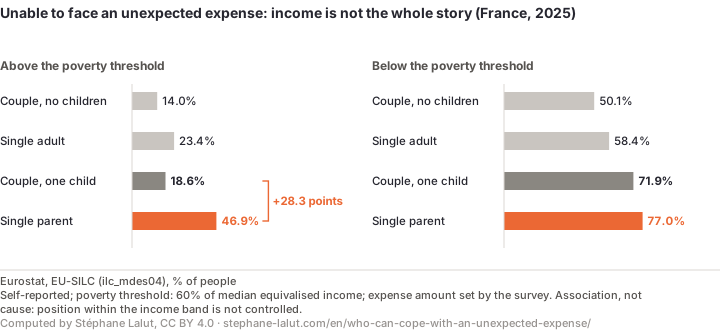
Is being unable to face an unexpected expense a matter of poverty? Only in part. In France, in 2025, 65.9% of people below the poverty threshold are in this situation, and 21.6% above it. But above the threshold, household composition sharply separates situations: 46.9% of people in single-parent households could not face an unexpected expense, against 18.6% of people in two-adult households with one child.
Data as of: 26 October 2026 Eurostat, EU-SILC survey, dataset ilc_mdes04: France and the EU-27, full series since the start of the survey; gaps studied from 2015 to 2025. Download: CSV · JSON
Who could not face an unexpected expense?
In France, in 2025, 28.8% of people live in a household that, by its own account, could not meet an unexpected expense of €1,000 from its own resources: nearly three in ten. Income weighs heavily. Below the poverty threshold the share reaches 65.9%, about two thirds; above it, 21.6%, about one in five.
But income is not the whole story. Above the threshold, where an income-based classification says “not poor”, household composition sharply separates situations.
Share of people (not households), self-reported; poverty threshold: 60% of median equivalised income (Eurostat, EU-SILC).
The result in one sentence. In France, in 2025, above the poverty threshold, 46.9% of people in single-parent households could not face an unexpected expense, against 18.6% of people in two-adult households with one child, a gap of 28.3 points.
Two explanations, one test
One might think that everything turns on income: being above or below the poverty threshold. If so, two households on the same side of the threshold should show similar shares. The test compares households that differ first of all in one thing: one adult more or less.
With one child, moving from two adults to one adds 28.3 points above the threshold in 2025, and between 20 and 30 points every year since 2015.
Without children, the same move adds only 9.4 points (between 9 and 13 points over the same period).
The number of children is not enough to explain the gap. The statistics count as a “single parent” any single adult with one child or more; against two-adult households with two children, the gap remains 29.3 points.
Above the threshold, the gap between one- and two-adult households is thus two to three times larger with children than without. It persists throughout the series, but it does not isolate the effect of household composition itself: the number and age of children, employment, social transfers and expenses may also differ between these households. Below it, the gap narrows (5.1 points in 2025): people in single-parent households and in two-adult households with one child are both exposed in a large majority. Being above or below the threshold is therefore not enough to explain these gaps.
What the test does not settle. A third explanation remains possible: above the threshold, single-parent households might on average sit closer to the threshold than two-adult households with one child. The Eurostat dataset does not detail position within the income band, so it cannot separate what household composition weighs from what that position weighs.
The same finding across the European Union
In the EU-27, 29.2% of people could not face an unexpected expense in 2025. Above the poverty threshold, moving from two adults to one adds 22.8 points with one child (between 19 and 25 points since 2015), against 10.1 points without children (between 9 and 11). The finding is not specific to France.
What these data do not say
A statement, not a bank balance. The question asks whether the household could pay an unexpected expense without outside help or new borrowing; it measures neither savings nor available assets.
An amount below the common rule. In France, the 2025 survey asks about an expense of €1,000 (Insee). Eurostat’s guidelines set this amount, country by country, at one twelfth of the poverty threshold taken from the survey two years earlier, rounded to within 5%: about €1,209 for France in 2025, on the 2023 threshold. The French question therefore tests a smaller sum, which matters when its level is compared with other countries; it does not affect the comparison between French households, who all answer the same question.
People, not households. Shares are computed over people: a child in an exposed household counts as exposed.
The poverty threshold is relative. It is 60% of median equivalised income; it accounts for household size, not for the reserve the household holds.
An association, not a cause. The chart shows that household composition and vulnerability to a shock go together, not that one produces the other; position within the income band is not controlled.
Precision not published. Eurostat publishes no confidence intervals for these subgroups; none of the values used is flagged by Eurostat as of low reliability. That flag does not make a gap of a few tenths of a point significant: the page comments only on gaps of several points.
Breaks in series. Eurostat flags breaks in France in 2020 and 2022: multi-year ranges should be read with caution. The main finding compares households in the same year, and the break does not affect it.
To go further: La Société du premier coup (in French) tells, through concrete cases, what a failure costs depending on the social position of the person who suffers it, and why some cannot afford to try.
Frequently asked questions
What share of people in France could not face an unexpected expense?
In 2025, 28.8% of people living in France say their household could not face an unexpected expense (Eurostat, EU-SILC survey). The share reaches 65.9% below the poverty threshold and 21.6% above it.
Are people in single-parent households more exposed, even when they are not poor?
Yes, and the gap is widest above the poverty threshold: in 2025, 46.9% of people in single-parent households above the threshold could not face an unexpected expense, against 18.6% of people in two-adult households with one child, a gap of 28.3 points. Without children, the same move from two adults to one adds only 9.4 points. This is an association: the series does not say whether the gap comes from household composition or from a lower position within the income band.
Where do these figures come from?
From the European survey on income and living conditions (EU-SILC), Eurostat dataset ilc_mdes04 (series from 2003 to 2025), retrieved by a script that stops if a figure no longer meets the conditions on which the page’s main sentences depend. Only the amount of the question, €1,000 in France, is transcribed from an Insee publication, and checked for each survey year cited. The data can be downloaded as CSV and JSON, under a CC BY 4.0 licence.
Sources
Eurostat, European Union Statistics on Income and Living Conditions (EU-SILC), dataset ilc_mdes04 (“Inability to face unexpected financial expenses”), retrieved through the dissemination API. Author’s calculations: gaps between household compositions, annual ranges.
Amount of the question: Insee, press release launching the SRCV survey, 31 January 2025 (in French: “are you able to face an unexpected expense of 1,000 euros?”); common rule: Eurostat, EU-SILC Methodological guidelines, 2025 operation, variable HS060, p. 154; poverty threshold for a single person: Eurostat, dataset ilc_li01, retrieved by the script.
Reusing this page
The charts, the data and a ready-made citation, under an open licence. Each chart carries its source, vintage and reading caveat inside the image: reused in a lecture or an article, it does not come apart from what makes it readable.
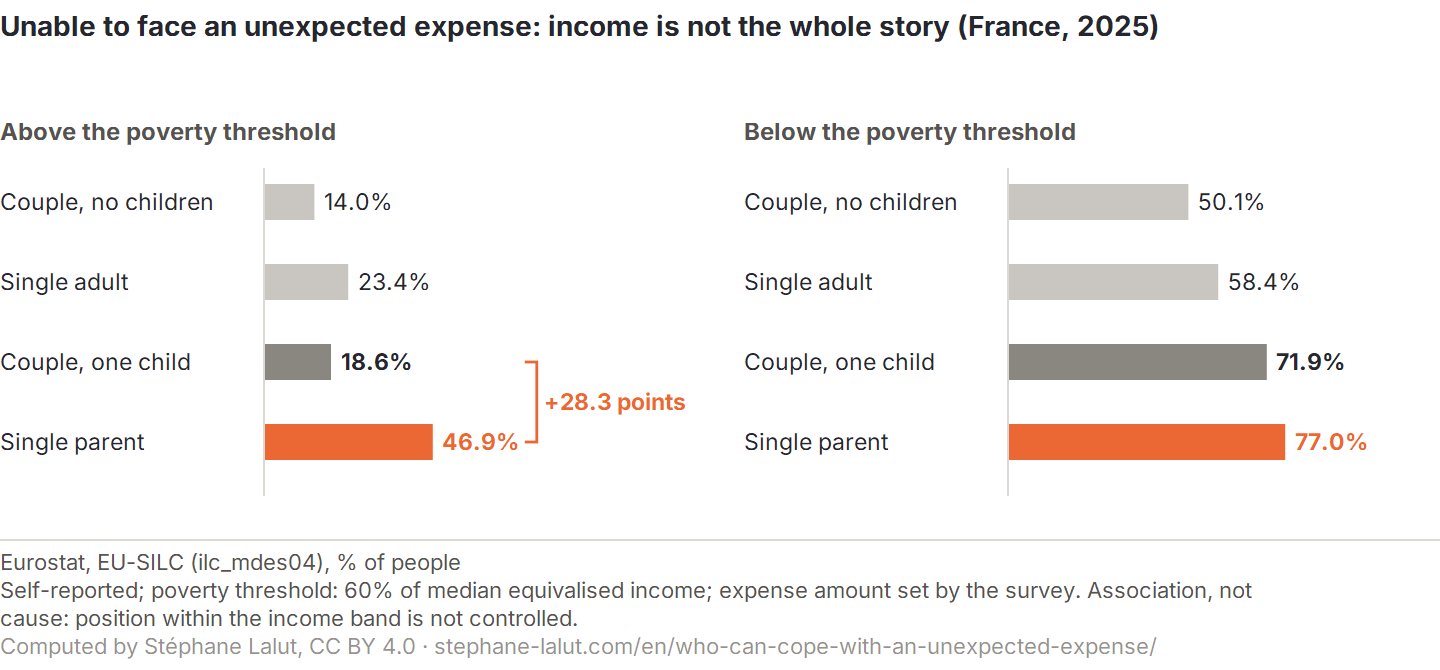
Unable to face an unexpected expense: income is not the whole story (France, 2025)
Above the poverty threshold, 46.9% of people in single-parent households could not face an unexpected expense, against 18.6% of people in two-adult households with one child: relative income does not tell the whole story about coping with a shock.
Reading caveat. Self-reported; poverty threshold: 60% of median equivalised income; expense amount set by the survey. Association, not cause: position within the income band is not controlled.
Lalut, Stéphane (2026). “Who can cope with an unexpected expense?”. Eurostat (EU-SILC) data, retrieved 26 October 2026. https://stephane-lalut.com/en/who-can-cope-with-an-unexpected-expense/
In three sentences
Above the poverty threshold, the share of people unable to face an unexpected expense is more than twice as high among people in single-parent households as among people in two-adult households with one child. When there are children, the gap between one- and two-adult households is two to three times larger than without children; this is an association, not an isolated effect. Relative income therefore does not tell the whole story about coping with a shock.
The data
The share of people unable to face an unexpected expense, for France and the EU-27, by household composition and position relative to the poverty threshold, every year since the start of the survey; the same content is available as CSV, in long format, with Eurostat’s flags.
Data and charts CC BY 4.0 — free reuse, including commercial, with attribution. Text under copyright — short quotation free, full reproduction on request. The raw series belong to their producers (Eurostat (EU-SILC)), under their own terms.